
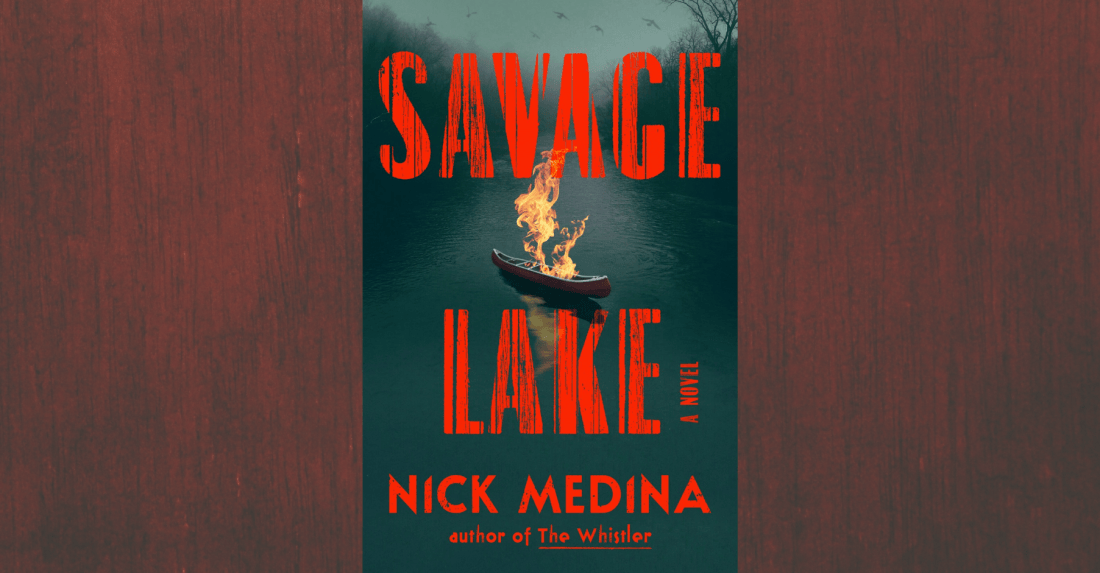
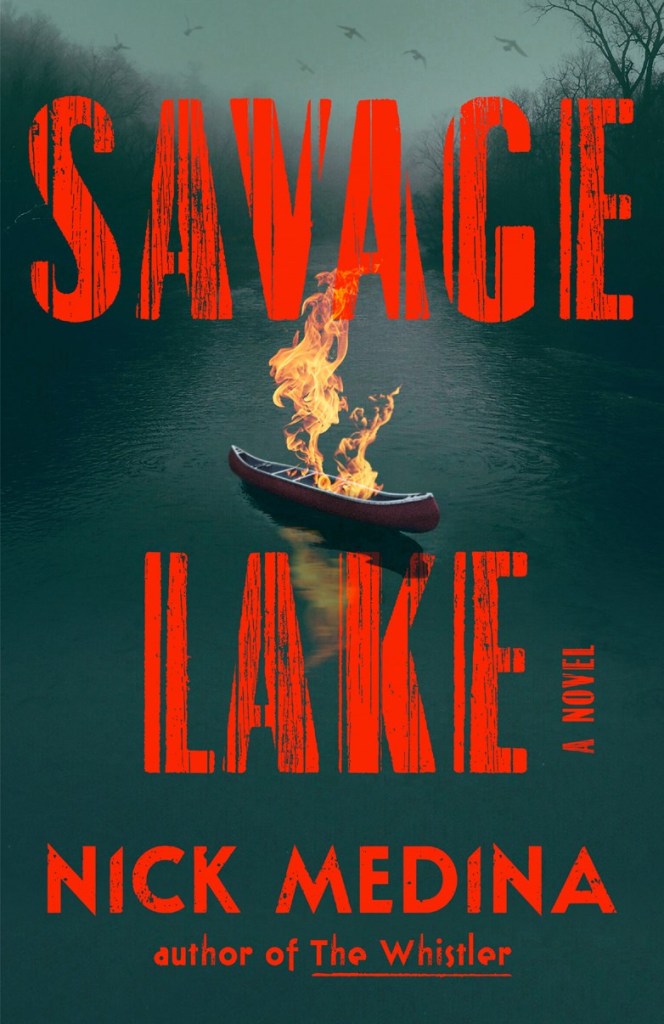
Nick Medina’s latest novel, Savage Lake, arrives just in time for Halloween, even though the setting is a picturesque summer lake house. As he did in his previous book, The Whistler, Medina taps into the truer horrors of everyday life and relationships. There may be literal ghosts and monsters in the world, Medina suggests, but at the end of the day, the things we should fear most are already inside: inside ourselves and inside the people around us.
Medina does an excellent job of adapting a setting that might not seem like an obvious choice for a horror novel and highlighting its isolated rural nature, which dovetails with the slasher genre. The stakes are raised further when Medina’s protagonists become physically trapped at the lake house by local politics. In a move borrowed from the real-life dispute between the town of Lac du Flambeau, Wisconsin, and the Lac du Flambeau Band of Lake Superior Chippewa, Savage Lake’s local tribal leaders barricade access to roads to put pressure on the town, which has not paid land-use rights as agreed. The barricade’s real-life parallels are just one of many ways Medina incorporates Native perspectives and addresses social issues throughout the novel.
Savage Lake alternates between two timelines. The present-day storyline focuses on 18-year-old Oscar and his mother, Nell, as they attempt to prepare the lake house for sale after Nell’s father’s death. Oscar is eager to get the work done and get back to Chicago, where his summer job and a potential date with his high school crush await. Oscar’s obsession with horror films and his lack of familiarity with the rural setting result in near-constant anxiety, as he mistakes virtually everything he sees or hears for something spooky. Osar also incorporates things he sees into an imagined horror movie, what he calls “the horror movies in his mind.” Specifically, he fixates on the five teenagers occupying a nearby lake house, watching them through binoculars and imagining their fates if they were in a horror movie. Because he doesn’t know their names, he refers to them by stereotypical horror roles: the girl next door, the jock, the hot blonde, etc., and, of course, they all end up dead. These seeming digressions prove significant, and there is something distinctly unsettling about the lake house and even the lake itself. But the horror is more deeply seated than Oscar imagines.
Nell would rather not be at the lake house at all, and the second timeline narrates her experiences the last time she was there, in the summer of 1999, with her parents and her older brother. Nell’s 1999 experience is characterized by racism, misogyny, and the widening distance between members of her once-close family. While the surface-level events of the novel are par for the horror novel course, some of the most dramatic moments occur when young Nell observes the growing hostility toward her brother, both in their home and in the wider world. In the best horror tradition, the novel gestures toward real-world questions of who is allowed to feel safe and where. As Nell’s chapters progress, violence between her brother and father escalates as Nell looks on. Alcoholism plays an undeniable role in the growing conflict, and by the end of the summer, Nell’s brother is dead.
The mystery of what happened to Nell’s brother and the rift his death created within her family reverberates through the lake’s landscape, Oscar’s relationship with Nell, and the lives of the locals with whom Oscar begins to form friendships. As he and his mother are forced to spend more time at the lake house, her mental health declines, and Oscar becomes increasingly focused on discovering the truth. While there are a number of viable suspects, including Bigfoot, the reveal of the actual killer is both surprising in the context of the novel and somewhat mundane if we consider the most likely suspects in a real-world scenario.
Both the death investigation and the barricade situation allow Medina’s novel to speak to real-world concerns. While some may be surprised at a horror novel having social justice messaging, it is quite common for horror fiction to engage directly with cultural fears and concerns. In Medina’s storyworlds, racism is one of many horrors presented on the page, but as Medina puts it, “unlike Bigfoot, it’s a monster with more than enough evidence of its existence, and no good has ever come from ignoring it.” Despite these somewhat heavy thematic resonances, the novel is often fun, with moments of humor woven throughout, and for readers like myself who have a fondness for the slasher subgenre, Medina’s take on longstanding tropes is well worth a read.
FICTION
Savage Lake
By Nick Medina
Berkley Books
Published October 27, 2026


